Science Fiction Though the Decades

Friday, April 6, 2012

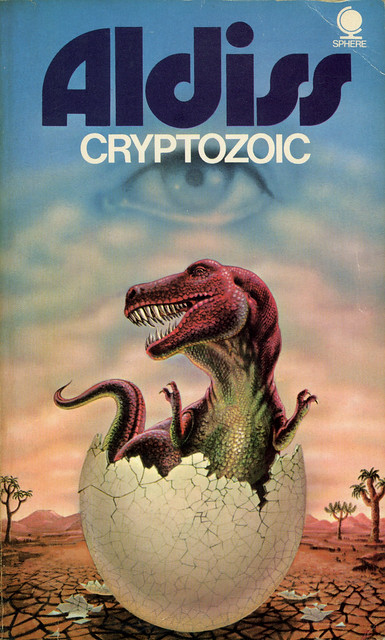
1967: Cryptozoic! (Aldiss, Brian)

Chronological and Psychological mind blow (4/5)
From July 12, 2011

My eighth Aldiss book to-date and I haven't been disappointed in any of his novels yet (while the collection in The Saliva Tree was great, the other two of Last Orders and The Book of Brian Aldiss left something to be desired for). Cryptozoic is pretty trippy, more so than Earthworks. But why else would you read Aldiss? He's got BIG ideas! Cryptozoic was originally titled An Age and was serialized in three parts from October to December 1967.

Rear cover synopsis:
"Mind-travel through the time-entropy barrier is the perfect recreational escape. It's expensive, sometime dangerous, but always fascinating. Edward Bush has travelled millions of years through the earth's primordial past, sketching the strangely beautiful landscapes of the Devonian and Jurassic ages. New he is searching the past for a man the dictator wants eliminated. And when he finds that man, Edward Bush will be hurtled across eons, against the flow of time. Waiting for him at world's beginning, in the violent cauldron where no life exists, is a future that mankind could never have foreseen... the utterly alien horror of time uncreated."

The word "cryptozoic" is hard to type out. Also, it's kind of hard to figure out. Near the end of the twenty-first century, time travel via the mind became a reality. The body would stay in 2093 but the mind would whiz back to the Jurassic era, Devonian era or even the Holocene epoch if you've got the talent. Prohibitively expensive, mind time travel is reserved for vacationers wanting to visit the mind-colony in the Jurassic era or ride their mind-motorcycles through the ages. More importantly, a research institute sends scientists or artists out to view and record the landscape of history, however, interaction with the environment is impossible.

Bush is the man we view this pan-chronological world through... from land-walking fish, to tyrannical lizards of yesteryear and to his modern day dystopia where America has crumbled and is now under leadership after leadership of tyrannical generals. Bush is a victim of Freud's oedipus complex: he's fixated on his mother and not on the best of terms with his father. When Bush learns of his mother's passing away, he joins his father in drinking binges even though he know at his father's frail age, the hooch will eventually kill him (half of the oedipus complex). Incest is a running theme though never actually consummated. This is definitely a chronological and psychological mindblow.

All goes very well for most of the book. The second half sees Bush go through military training to become a time-assassin and things get even more weird thereafter. You've really got to hunker down and concentrate on the mind time-traveling... Bush jumps to the immediate past of his own present and stops an action which is in action during his old present (umm, anyone get that?). Further into the last half, there are some more ongoings which really challenge your grip on the English language when it comes to the NOW, the PAST, the FUTURE and FATE. It's a big idea and it's pretty hard to grasp - but if you do, it's very rewarding!

5-stars for the mindblow but subtracting 1-star here for the internal logic of Bush which goes missing in the pages. Alliances change on his side and the "other" side, he was against him and now he's for him, and why exactly was he in training? Just a bit of the book is sketchy like this, but pick it up and read it for the big ideas!

Wednesday, April 4, 2012

1984: The Pandora Stone (Greenleaf, William)

Linear plot of vying for an alien artifact (4/5)

William Greenleaf was a minor science fiction writer in the 1980s, beginning with a single publication of his freshman novel Time Jumper (1980) and later with more single publications of his novels The Tartarus Incident (1983), The Pandora Stone (1984), Starjacked (1987), and Clarion (1988)... three of which were published with Ace. Enjoying a revival of sorts, Greenleaf has been making his novels more accessible with some digital versions now available. If Tartarus and Pandora are a testament to his creativity and cleverness, then the rest of his works are to be hunted down in paperback format and enjoyed.

Rear cover synopsis:
"Arlo Field didn't match the holo-vid image of a contract courier--he was short, scrawny and homely, and he suffered from recurring nightmares about his one encounter with the alien cobra, an encounter is which his lover was killed. But Arlo was good at his job--so good that when UNSA needed someone to acquire and transport a mysterious alien crystal to headquarters on Sierra, Arlo got the assignment. Unfortunately, nobody told him that the five more ruthless criminals in the human k-stream loop also wanted the crystal. And would stop at nothing to get it."

A genuine alien artifact which was stashed away by a noble, well-intended scientist has gradually come to surface on the black market. The artifact, a crystal the size of a large man's fist, is currently owned by a reclusive but well-to-do business man by the name of Steele. With pressure from hierarchically coming from above, Sherborn Tharp hires Arlo to purchase the crystal and return it to him, no questions asked. The Deputy Assistant of Security for the United Nations Space Administration (USNA), Tharp, cannot envision the perils which lay in deep space for Arlo, nor can he contemplate the importance the crystal has on humanity's place under the stars.

Once the crystal is handed over to Arlo and he secures the metallic attaché case to his wrist, the craft he is flying in is almost at once attacked by the Guard. Stumped by whose allegiance the Guard is under, Arlo knows for certain that trust cannot be wantonly given to passers-by. His dramatic rescue by a female pilot plunges him further into cross-weaving agendas for ownership for the crystal. Dodging criminals, scoundrels, and general lowlifes, the two keep a low profile on a mining planet while those who vie for the crystal's power tie up loose ends... which requires ammunition to be spent and blood to be spilled.

Without an allegiance to any of the vying parties, Arlo eventually places a limited amount of trust in his rescuer, the female pilot/lithesome companion Tabby Brooke. Her prerogative of returning the crystal to earth is unsettling to Arlo, as his knowledge of earth concerns its mutated inhabitants and derelict cities; the Plague survivors of earth, the Sgor la Lyurr, are seen as primitives and little could connect them with the extraterrestrial artifact.

In an arm of the galaxy colonized by humans, no benevolent alien life has been found, while one alien raced, named the cobras, are savagely at war with the humans. A seemingly blood-thirsty race, once such conflict has forever scarred the mind of Arlo as he saw his friends die one-by-one by the single vicious attack of a cobra. But it are the cobra, too, who find that ownership of the crystal is the most dire need for the continuation of their race.

This is only my second Greenleaf novel but I can summarize his style as this: technically specific but without the mumbo-jumbo typically associated with it, fast paced but without missing large tracts of plot, character-based but not superficially glazed, and attentive to detail without being obnoxious or repetitive. The entire composition comes off very cleanly without the sanitized sensation of a paint-by-numbers novel.

When I say "technically specific" I don't mean page after page of scientific detail or a step-by-step physics lesson ala Charles Sheffield, Greg Egan, or Bruce Sterling. Grreenleaf isn't so specific as he his attentive to the environment the characters are placed in and interact with (hmm, well put): "The girl folded the flight control wheel into its niche under the console. She keyed a command, and the craft's grav control set the level at Terran standard." (35) "He flipped the switch to borrow power from the idled drive engines. The commset speaker burped once, then began issuing a faint hum." (41)

All this provides a fairly homely feel for where the characters are placed. When the cast are set in a spaceship, an office, a bar, or a hotel, Greenleaf follows through with this importance of character environment: "Their room was as dismal as the rest of Bly Harbor. The furniture consisted of a word couch and a bed that sagged in the middle." (61) "The towers that cast shadows across city blocks were of the same squared designs of concrete and glass [...] Rusted heaps of apparatus squatted on the flat roofs." (161)

Everything that Greenleaf mentions in The Pandora Stone is relevant to the plot. There aren't any loose threads, no red herrings, no parallel plots of annoying brevity, and no social or political diatribes. He's written a very well packaged science fiction book, perhaps common to the 1980s but taken with a sigh of relief before the 1990s trend of 500 page tomes somehow became fashionable. All the aliens, all the technology, all the groups vying for the crystal, and all the histories leading up to the climax are important to Greenleaf's plot. Maybe it's not exactly Hugo material or spiced with philosophy, but it is an exciting novel which entertains... something which most Hugo authors tend to forget about.

Along with William Gibson, Greg Bear, and Larry Niven, William Greenleaf also provides an entertaining 1980s novel in comparison to the lengthier and more weighted likes of Kim Stanley Robinson, David Brin, and George Alec Effinger. Greenleaf provides the perfect recipe for flawless entertainment, at the cost of being simple and structured but not juvenile or scripted.

1983: The Tartarus Incident (Greenleaf, William)

Science, horror and human error (4/5)
From April 30, 2010

From the front cover: "Trapped in the catacombs of a decaying planet, five desperate space travelers are stalked by the only thing in the universe hungrier than Man." This sentence is a very enticing mini-synopsis but mostly describes the plot condition in the last half of the novel: the horror part of this science fiction/horror novel. The first half of the novel is an original and well-written piece of science fiction. If it were to have a similar mini-synopsis, it would read: "Stranded in the desert of a searing planet, five auditors are coping with the only thing in the universe more dreadful than Taxes." That dreadful thing is the long running basis of the plot: the accumulation of human error.

The rear cover actually provides a good synopsis of the first half of the book:
"'Somebody get us the hell out  of...' This was the last transmission received from Oliver McElroy's audit team. What could never happen... was now a terrifying fact. The five-person crew of the UNSA audit ship jack-a-dandy had simply disappeared during a routine materialization from Graywand station to the planet Sierra. It was the end of their comfortable routine, and the beginning of the interstellar nightmare know as The Tartarus Incident."

I originally gave this book a three-star rating, but I've upped it to four stars because the horrific catacombs in the last haunt me to this day. I'd say the contrast of science and horror was very vivid and provides a long-term thrill!

The style of writing is nondescript but lends itself to be easy on the brain, where it can easily be read in the span of 3-4 hours or within two days of on and off reading. The first half of the short book is the inventive science fiction bit. Greenleaf has the sense to create a novel propulsion unit for the ship, which inevitably goes haywire and strands the crew on the arid planet. This half is full of tense scenarios and tricky problem solving. Intermixed, irritating and interrupting the easy flow of reading are random childhood memories of some of the crew. These insights don't cast a new light on any of the fairly generic crew of five auditors. The second half is the horror section of this book, which takes place in an underground labyrinth. The maze of passageways is detailed but still lacks a defining characteristic: it's dark, it's full of creepy crawlies, and it's dilapidated. The cavernous abyss between the two halves of the book is laden with an eerie foreboding, outlined here in a sequential manner: "The dead city waited under the sun-glazed air." (64) "He sat there a moment longer, feeling the hot breath of the city all around him. And suddenly, for no reason, he was afraid." (65) "[...] with the blazing city all around him and his mind touched by the presence of those who had built it, he could see himself with painful clarity." (66-67)

The resulting tectonic shift of the plot is rather annoying (but stands the test of time) as Greenleaf had an excellent, classic sci-fi novel on his hands as the plot itself was problem-solution based. Sporadic science-based endeavors are included in the second horror half, easing up on the intensity involved down below in the arid catacombs of the scorched planet of Sierra. All in all, it's not such a bad novel as it's a quick and easy read but the story still sticks in your mind due its trying circumstances, terror filled darkness and the realization that sometimes situations are out of our hands because of accumulated human negligence.

Friday, March 30, 2012

1977: Cloudcry (Van Scyoc, Sydney J.)

Fantasy land of prolific adverbial rubbish (0/5)

A brief philosophy on "What is Science Fiction?":

This book is clearly labeled on the spine as science fiction. However, there are many shades of gray between the nebulous "speculative fiction" realms of "sci-fi" and "fantasy." Every book lands on its own position between the two--rarely is a speculative fiction book without favor for one side of the genre spectrum or the other. I see the spectrum to be linear, allowing an author to make a sci-fi book more like fantasy by adding or withdrawing certain elements. The same goes for fantasy books which can be geared up to read more like science fiction. This latter process is a tetchy endeavor as some science fiction fans like myself abhor the genre of fantasy. James Alan Gardner's Trapped and Fritz Leiber's Gather Darkness ride this fine line and both come away as solid science fiction because the use of magic is outlined under the umbrella of future science. The same cannot be said for Cloudcry. The title alone is more reminiscent of a fantasy novel, as are Van Scyoc's other novel titles: Darkchild, Starmother, Featherstroke, and Bluesong.

You be the judge while reading the rear cover synopsis:
"Where Immortality is More Than a Dream
From the dawn of time the Light Dancers sailed the cloudplains of Selmarri, until they discovered immortality--and traded their wings for eternity in a crystal universe the size of a transistor! Aeons later, when the bloodblossom plague threatens to reduce humankind's lifespan to nine Earthyears, the "empty planet" Selmarri is chosen as quarantine for the galaxy: and the exile Verrons and the Light Dancer Aleida respeak the sun-leaping cloudcry in their pursuit of life's most ancient dream..."

One more additional frame of genre reference is the following paragraph. Again, you be the judge... fantasy of science fiction?:
She was so near, the refined crystal in hand, the secret of its implantation already recorded somewhere in the issues of her brain. But she could not retrieve that information without appropriate stimulation, and stimulation lay below, in the hall of the master flute--beneath the solid stone floor. (207)
In my opinion, the entire novel has been generously tweaked in order to alter it from a rather mundane fantasy novel into a terrible excuse for a science fiction novel... not because the "science is bad" but because so many elements could simply be switched, turned on or turned off, to render it as a fantasy novel:
(1) The inclusion of CRYSTAL in almost any novel is warning enough for me to stay clear of the book because of their mystical affiliation; hence the fantasy connection. Why not just call it a crystal ball?
(2) As for FLUTES? The science behind the flute is weakly outlined, but if it were to be excluded then the fluted would have mystical qualities!
(3) The avian alien Tiehl doesn't have to be described as such, perhaps describing it as an "Icarus" or a netherworld sentient Rho would be enough to have a fantasy feel to it.
(4) Instead of having beam pistols, why not just call them magic wands which cast heat and pain to the victim? Instead of spaceships, why not just call them dirigibles or zeppelins? Instead of the alien plague bloodblossom, why not just call it the Demon's Disease of Dastardly Death?
(5) Really, I could go on.

Aside from the fantasy elements which irk me something fierce, Van Scyoc's writing style sent me into a state of extreme frustration and anger--it drove me up a very tall and perilous wall, which I was tempted to jump from after I wanted to tear the book apart and make personal compost of it. She is heavily repetitive, using the same phrases over and over again: "nodded abstractedly" and "ruffed his plumage" and "her hair crackling" being among the most annoying. Her extremely liberal use of "-ly" adverbs had me clinching my teeth and squeezing my eyelids shut in sheer agony. Her open-handed cramming of "-ly" adverbs into each nook and cranny was amazing... amazingly bad. Her top seven most repetitive -"ly" adverbs: quickly, slowly, certainly, swiftly, briefly, apparently, and emphatically. To give you an idea of how often she uses adverbs, I roughly counted the number in a random 10-page section and I include here some of the doozies:
Pages 154 = 7 times (uneasily paced)
Pages 155 = 8 times (uneasily paced [again])
Pages 156 = 15 times (apparently flew AND apparently located)
Pages 157 = 9 times (gingerly buckled)
Pages 158 = 5 times (expertly tossed)
Pages 159 = 11 times (desperately labored AND desperately broke)
Pages 160 = 6 times (preternaturally alert)
Pages 161 = 10 times (thoughtfully said)
Pages 162 = 13 times (swiftly barreled)
Pages 163 = 5 times (dispassionately noted)

More contextually, here's an "-ly" adverb-laden excerpt:
Cautiously they edged past the first dome and around the first of the second rank. Verrons tapped the translucent panel lightly. It was a plaston material, virtually untouched by deterioration. He pressed his forehead to the paneling. Within the dome shadowy forms were stranded in silent immobility. (168)
Take ALL this into consideration when you come across flowery after flowery passages of gobbledlygook English. Some authors can get away with writing beautiful prose in the middle of each page (John Updike, for one). But an author like Van Scyoc to absolutely plaster the pages with semi-intelligible attempts at the pollination of prose reeks not of cherry blossoms, but of desperation: "His jiggling eyeballs anchored desperately upon Verrons' reassuring solidity." (121) and "[...] her body arched in fervent proprietorship." (122) Also, her sequential use of big words becomes quite annoying: "But the very unlikeliness of the phenomenon demanded the flexibility of a solitary investigation." (49) and "His body tightened in recognition of appropriate entombment." (101)

Like most of Cloudcry, the above passages are examples of the petty and garrulous descriptions of every item and action; the discursive use of all things adverbial; and the inability of the author to be textually taciturn (K.I.S.S. should be written on her wall as a note to herself). I was gagging for the plot to move forward as it was heavily weighted with textual rubbish. I was so relieved after finishing this book that I screamed at the cringe-worthy cover and chucked the book across the room... only the second book to have such an honor.

Sydney J. Van Scyoc... never again shall we cross paths.

*** Fourteen "-ly" adverbs were intentionally abused in making this review ***
1950: Gather, Darkness! (Leiber, Fritz)

Science, Magic and Religion without the Fantasy (4/5)
From November 15, 2009

I was skeptical of a "science fiction" book which read on the cover, "An epic struggle between science and magic" with an illustration of an old lady, a cat and a monkey. If it wasn't for my prior research into the book, I never would have even touched the book.


Rear cover synopsis:
"Brother Jarles was afraid. Everyone was afraid. The power base of the false religion was crumbling as its scientific miracles proved to be fakes. Now mankind was in the depths of a new dark age, but the priests could offer no hope. Angels and devils warred in the skies, and the witches were stirring up new and terrible marvels. So Brother Jarles turned to the Dark Man, with a last faint hope in his renegade heart. There was no haven for him in this future world locked in turmoil between decadent science and what seemed to be resurgent superstition. Jarles was essentially a simple man, but there were no simple answers. Even the Great God of the temple was no longer safe. Then the great warships began to land from Heaven."

I'm allergic to fantasy, so I have a most difficult time swallowing magic, witches and spells. One book which repressed my gag reflex was Trapped by James Alan Gardner. In his novel, the characters exhibit their magic in the form of manipulating nanites which are specific to each owns brain chemistry... or whatever. Anyway, it was readable. Now when I pick up a classic like Gather Darkness, which includes elements of magic AND religion, I was suspicious. Fritz weaves a decent tale though without causing me to spew.

In the era the novel takes place, a Hierarchy has been long established which uses masqueraded high-technology to mimic miracles of God and powers granted to the priests. The commoners are draconian yokels left in the dark about the secret affairs of the church. Yet, there is a secret resistance invoking Witchcraft (so says the Church, but it is in fact technology which the Church doesn't have). The story follows the resistance of the Witches and heretics, the escalating war between the two, and friction which spills over into the populous city.

Considering the three later-combined short stories were penned in 1943, a number of remarkable technologies make their appearance. One could say that Fritz was, perhaps, visionary in his technological apparatuses and memes. His ideas were also original, something which is hard to sift through when going over pulp 40s and 50s science fiction. Even now, the novel stands as a one-of-a-kind science fiction novel which only touches base with very few other novels combing scientific magic and religion.

This quirkiness and ingenuity of Leiber's science/pseudo-science extends to Leiber's short stories, too. The Best of Fritz Leiber (1974) is a collection of twenty-two short stories and it a must for any fan of unique science fiction. It'll be worth your effort to track down anything Leiber has written, but my whole-hearted recommendation is to pick up both Gather, Darkness! and The Best of Fritz Leiber.

Thursday, March 29, 2012

1971: Abyss (Wilhelm, Kate)

In the abyss of dichotomy lies a reality (3/5)

Having read Wilhelm's flagship post-apocalyptic novel about cloning, Where Late The Sweet Birds Sang (1976), her three-part story was captivating but a special something was missing--her writing didn't set her apart from other writers. Her much lesser known work, Let the Fire Fall (1969) combined religious fanaticism with an alien contact novel, but once again her writing style was no where to be seen and unfortunately her plot line wasn't very lively. Besides her work in science fiction, Wilhelm also used to write a good deal of mystery. In Abyss, both lines of her fiction writing are merged into two separate novellas where the mundane circumstances transmogrify into the creepy realm of testing your own reality while at the lip of the metaphorical abyss.

----------

The Plastic Abyss (1971) - 3/5 - Perry Davenport is the president of a plastics company who is eager to secure government funds for the research into a nearly all- absorbing material, rending it impossibly dark and suitable as a platform for image projection or energy generation. The director of research, Gary Hazlett, is against any government collaboration in the invention because he fears the government monopolization and militarization of their discovery. Meanwhile, Gary's wife Dorothy is experiencing conflicting memories of time and place. Her continuing dichotomous memory spurs her into confused fits of what reality: is there more than one reality or is everything she projects a non-reality compared to her corporeality? When the research group and the couple come together to pan out what experiences can be corroborated, the slow collective realization is as unsettling as it is illusionary. 71 pages

Dorothy's fractal experiences are difficult to follow at first, where her version of reality differs from the corroborated experiences recounted by her husband or neighbor. In each circumstance Dorothy has a presence, but which presence is her own is not known from that of her proposed doppelgänger. Her flighty behavior is seen as a female neurosis in the eyes of the predominantly male cast--she's skittish, uncertain, overly emotional, and needy. The stereotypical female-in-need is compounded by the stereotypical male-problem-fixer, where I would typically feign interest in such a superficially characterized cast, this character symbiosis is as interesting as the juxtaposition of knowledge-based scientists and surreal-experiences of Dorothy. Something works very well here, but the displacement of Dorothy and her perceived reality is hard to pin down into words... the story might have been handled by Brian Aldiss or John Brunner.

----------

Stranger in the House (1968) - 4/5 - Robert and Mandy have made the move from the city to the country, where they have bought a huge house for a very affordable price. A series of odd events involving physical sickness, fainting spells, and spasms of agony have Robert unperturbed. Mandy and her 29-year old daughter share unsettling experiences of being mentally invaded and inherently distrust the house. Below the basement of the seemingly haunted house lies an alien being, the Groth. On a mission to monitor the scientific developments of humankind since 1896, the male Groth has become withdrawn, distressed, and depressed after the untimely death of his mate. Unacclimated to earth's atmosphere, the Groth finds it difficult to return to its ship located in upstate New York. All his needs taken care in his subterranean lair, the Groth doesn't need to venture out often but he also needs to complete another one of his missions on earth--to make contact. However, his telepathic powers and state of distress prove to be too powerful for productive reception in the human mind. 64 pages

The male-female struggle for whose idea of reality is more well-founded is just as prevalent as it is in the previous novella. Robert is a bullheaded realist with both feet planted to the earth while his wife Mandy suggests supernatural sources for the odd events in the house; between the two lie an abyss of the realization of the event in their lives. I guess you can take the metaphor as far as you like: the abyss between human and alien existence, the abyss between the continuation of life vs. the pull of self-death, the abyss between avoiding the truth and confronting the truth. The focus on the plight of the alien is the highlight of the story. The Groth is steeped in lonely misery as he can't conveniently move about, can't retrieve his spacecraft, can't effectively communicate, and can't complete his mission.

----------

I criticized Wilhelm for not having her own voice in her writing, but in this two novella collection, Wilhelm does do one thing quite well: offering unique insight into the human experience. It's not with every author that tidbits of pertinent insight gets slipped into the story. Wilhelm has a knack for this, she includes some facets of insight which I thought only I have experienced.
Her mother ... her father ... All of them pretending so hard, all of them so phony, always playing roles, being so nice and polite, and all the time just waiting for her to be out of the way so they could let down the masks, be themselves. She tried to imagine that her mother was like apart from her ... and she couldn't. Another person, a stranger to her. (13)
 and
We never see what we think we do. It's a matter of training. We see lines, and we join them. We see partial figures, and we complete them. We see randomness and we make it orderly. Our minds refuse chaos, so we train our eyes and our brain to create order. (64)
Her perception and human insights unique to this collection now has me more interested in her stories. I may steer away from her novels and venture towards her short story collection. There's still hope for her yet!

1969: Let the Fire Fall (Wilhelm, Kate)

Xenophobic fanatics - all too real (3/5)
From September 14, 2011

Kate Wilhelm's Where Late The Sweet Birds Sang was the first novel I've read by the author. While considered science fiction, it didn't use the science as a a focus or as a crutch, but more as a tool for the plot. The same could be said for Let the Fire Fall. The inclusion of an alien in the plot isn't for the sake of using it for science fiction, but merely for the use of a tool in the plot, as a way to incite a drastic change in society.

Rear cover synopsis:
"The alien starship landed in a cornfield. Its crew died rapidly, leaving only one survivor - a baby, conceived on an unknown world, carried in its mothers womb across space and delivered even as the mother died on a hostile Earth. But the alien woman had given birth to more than a child. With her last act she bequeathed to the Earth that hated her and her kind decades of turmoil and strife that would come close to tearing the whole planet apart..."

After the spaceship lands and the crew begin to die, one particularly immoral young man, Obie, decides to base a religion on the hatred of the strangers. This same young man is the illegitimate father of a child to be born the same day in the same house as the alien baby (the mother jettisons away from the virulent craft to the doctor's house, where he tends to both mothers' needs). With society's fear of the plagued aliens rampant, Obie finds a toehold for his ersatz faith and declares himself a prophet of God.

The chapter passages tend to shift time periods and character POV in abutting paragraphs, making it jarring to follow coherently. And as Obie's religion spreads across the country over two decades, the span of time becomes important as to the development of the human child and the development of the Star Child, of whom Obie seeks to proselytize his farcical faith for him. The span of characters is manageable but the initial chapters are a tad confusing with the inclusion of nearly all the key players.

The plot was fairly predictable and many of the twists of plot were a tad absurd (the Star Child's private submarine and private helicopter). Wilhelm even effectively kills off a major character (the obstetrician of the same-day babies) by putting him into cryo-sleep and metaphorically dusts off her hands for that snag in the plot. Those two instances are just samples of some of the things Wilhelm tosses into the mix in order to create an artificial change in the plot. It doesn't flow naturally.

Besides the irksome plot flow and paragraph flow, the premise is interesting at least and the books remains fairly readable though I wouldn't want to reread it. The fanatical xenophobic change in society when the aliens arrive is probably all too real. When the same xenophobes begin to turn against the human non-believers... again, it feels all too real. So, Wilhelm gets points for what I feel could be an accurate portrayal of first alien contact on earth. Definitely read Where Late The Sweet Birds Sang, but skip Let the Fire Fall.