Science Fiction Though the Decades

Monday, January 30, 2012

1972: Entry to Elsehwhen (Brunner, John)

Warning: Contains the worst novelette EVER (3/5)


As a big fan of Brunner's, it would be convenient for me to say that picking up a random Brunner novel should always be an exciting adventure... which would be true 66% of the time, but no sir, never 100% of the time. The same is true for this novelette/novella collection: 66% of it is quite good while the other 33% falls flat... and by flat I mean like paper-thin flat, elephant dung paper that's been compressed by a steam roller then sent to the surface of a neutron star. If you're NOT a hard core Brunner fan then I highly suggest you simply rip out the last 82 pages and leave yourself with a two novelette book worth reading.

Host Age - 4/5 - The rapidly mutating Plague is devastating England, where one victim in ten dies from complications which no two individuals exhibit the same symptoms. When leading research from the Plague's cure becomes destroyed and the investigation can find no sign of entry from the perpetrators, suspicion arise which implicate the recovering astronaut and the current theoretical research into matter transmission. 45 pages --- Only lacking spaceships, Host Age is a Golden Age-style story which combines all other science fiction cliques into one story. The result, contrary to prevalent cliques, proves to be one of excitement, intrigue, and mystery. It's not exactly character-based, but the plot's momentum is quite enough to convey Brunner's craftiness.

Lung Fish - 4/5 - On the way to Tau Ceti II aboard a generation ship, two generations of crew are is silent conflict: the logical Earthborn are taken aback by the unemotional Tripborn. With two weeks left before the arrival, the caretaker-minded Earthborn begin a secret plan to influence the Tripborn to become claustrophobic and eager to colonize the planet. 47 pages --- An excellent plot compounds an interesting juxtaposition of crew sects, but the conclusion feel pressed into an unnatural form.

No Other Gods But Me - 0.01/5 - Coincidental encounters between Colin and Vanessa become increasingly bizarre when they are transported to a strange abode as they huddle for safety from the heavy English rain. Along with a cloaked man stalking them and seeing shadows in their periphery, something clearly isn't natural. During a congregation of a fad religion in the heart of New York, the two are transported again to a parallel world with a psychic overlord, abysmal living conditions, and more telekinetic ability than Colin and Vanessa's earth could ever have... and there's a legless human boy who can fly. 82 pages --- The ONE hope I held onto was that the possibility remained that Colin, the lethargic body-double for a doorstop of a so-called protagonist, would commit suicide for the benefit of fictional mankind and for the well-being of science fiction readers across the globe. Possibly, the worst novella ever produced.

1974: Give Warning to the World (Brunner, John)

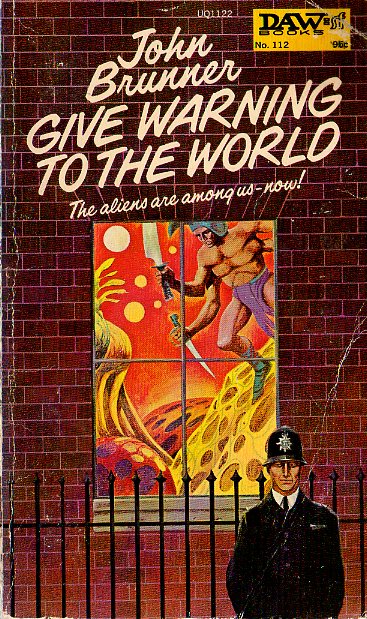
The cover is warning enough- Stay Clear! (2/5)
From June 10, 2011

Written in 1974 (the same year as his excellent Total Eclipse) near the end of Brunner's prime, I just couldn't pass up one of his novels even if it had a terrible cover displayed here . Tragically, this novel only had a single edition published by DAW (#112) way back in 1974. This is rather tragic because it follows in the footsteps of another Brunner tragedy entitled The Wrong End of Time (1971), also by DAW (#61). Those footsteps include the scathing 2-star rating... rare for a Brunner novel.

Across the street from slum housing, a police stakeout is watching the habits of the red-headed landlady who is suspected of 'serving' males in Soho district with whips and leather. The house she inhabits is home to a elderly lady in the upstairs and Clyde, a Jamaican actor struck with curiosity about the treatment of the young lady next door to him- Sally. Previous tenants have been disappearing and the police are also onto this but they are unable to connect the landlady/dominatrix to the mystery.

When inventor and deep-thinker Nick is driving down the road, the same beautiful but strange lady bursts into his car seemingly involved in a hallucination. She is taken away by her landlord who then locks her in her room. Though she is dirty and depraved of nutrition, she is continually injected with drugs to keep her sedated and confused. Nick discusses the incident with his doctor friend Tom.

Eventually, all the characters meet each other through one way or another, which stinks of luckiness and coincidence, which, again follows in the footsteps of The Wrong End of Time. It's an unbelievable unfolding of coincidence and the follow through of poor choices borders on agonizing. I was nearly yelling at the Nick 'Go to the police!' and 'Stop drawing grand conclusions to specific degrees!' and yelling to Brunner 'Get on with it!' So, yea, it's bit torturous to say the least. It reads like a run-of-the-mill police mystery/heroic savior type of fiction... but then (there's always a 'but then!' in these types of pulp novels) there's a science fiction twist at the last third when it's revealed the planet Earth is in danger. This screams of B-grade sci-fi film quality! It's pathetic for a Brunner novel.

An almost redeemable aspect of Give Warning to the World is the fifteen pages (10% of the novel) where we learn the entire history of the aliens at hand by the monologue of one character (I hate when this happens). The invention of the alien Yem by Brunner is pretty enticing but the novel's plot just has a terrible flow. I really wish he could have re-written the Yem into a more astute novel. Period.

I knew it was gonna be a stinker, but as a Brunner completest I HAD to read it. Now that I'm down with it, it will go the same way as The Wrong of Time- to the dusty shelves of the second-hand book store where many curious souls will eventually lay eyes on the cover and slip it right back onto the shelf. The cover is warning enough to the world to stay clear of the contents within.

Wednesday, January 25, 2012

2012: Blue Remembered Earth (Reynolds, Alastair)

Optimistic tale of humanity's collective potential (4/5)

Reynolds has always set himself apart from other science fiction authors by widening the scope of the plot to the nth degree, by infusing the setting with richness and depth, and by marbling all of this with awe-inducing science and technology. Akin to Revelation Space and House of Suns, Blue Remembered Earth proves he still has the gift for exhibiting unique ideas, penning an intriguing story, and capturing the imagination of the reader. It's not his best work, but it's definitely the great beginning to a surely great series.

At the end of the year 2161, after sixty years of solitude orbiting the moon, the empress to a solar system-wide company passes away. Her genetic legacy includes one pair of grandchildren, Geoffrey, who studies elephants on the African plains, and Sunday, who pursues sculpture in the Descrutinized Zone on the moon, away from the patrolling omniscient eye of the Mechanism. Controlling the interests in the family company are their cousins Hector and Lucas, who have a frosty relationship with Geoffry and Sunday. Once into 2162, the cousins bribe Geoff into traveling to the moon in order to recover the contents of a safe-deposit box once belonging to their wealthy and reclusive grandmother, Eunice. With agreement not to meet his sister when he's on the moon, Geoff breaks this treaty by visiting her enclave in order to unravel the mystery behind the contents of the box: a antique spacesuit glove which holds yet another mystery... colored gems.

Earth in the year 2162, as stylized by Reynolds, is one of African prosperity born from decline of the unmentioned Western nations and where humanity is recovering from the symptoms of a century of global warming. Pages 148-149 outline a post-warming earth, where sea levels had risen and were combated with seawalls, where the Sahara had extended its arid grip upon the continent, where depopulation had been enforced, where where humanity now derives its energy from deep-penetration geothermal tap and solar arrays spanning the globe, efficient transmission accomplished by superconducting cables. Once ill-weather regions of the earth now harvest grapes and produce fine wines, such as Patagonia, Iceland, and Mongolia. In contrast to this great human revival to calamity, there has been an unheard of decline in crime because of the nearly worldwide Mechanism, which uses algorithms to predict human behavior... each person with an augmentation connected to this incorruptible sentinel:

"Murder isn't impossible, even in 2162... Because the Mechanism wasn't infallible, and even this tirelessly engineered god couldn't be in all places at once. The Mandatory Enhancements were supposed to weed out the worst criminal tendencies from developing minds... it was inevitable that someone... would slip through the mesh." (278)

The plot has a feel similar to Chasm City and The Prefect, where a mystery is unraveled step-by-step in order to find the nexus of "what it all means." Jumping from the shadows of Kilimanjaro, to the lunar cityscapes, to the underwater expanse of the Panspermian Initiative, to the still inhospitable Martian atmosphere, and beyond... the scope of action on these and other settings is enough to please any space opera fan. Chuck in a few wholesome bits of orbital technology, mind transference technology, and a few spaceships - bam, what more could a hard sci-fi fan long for?

Plot aside, there is a core of characters which is tightly woven, numbering around six. It's easy to keep track of the ongoings, but when you start to toss in some far-flung family lineage, some transient personages, some representatives of human sects, and some semi-sentient corporal golem figures... you may need to keep a list if you're going to take more than three days to read this tome. A tome it may be, but it's not without its peppering of poetic prose:

"It was mid-afternoon and cloudless, the sky preposterously blue and infinite, as if it reached all the way to Andromeda rather than being confined within the indigo cusp he had seen from space." (154-155)

Nor it is without its share of humor, if you know your history of Mars in fiction: one character thinks the Martian city of Robinson is named after the novel Robinson Crusoe. The dialogue is less than airy at times, something Reynolds has been guilty of ever since Revelation Space. At times it's dry and recapitalizing. There's more swearing here than in his other novels, which is fine by my. Again, one more fault I found is a similar in fault to Chasm City: the unraveling is too convenient, the timing too auspicious, the clues too quickly understood, the backpedaling too awkward (i.e. the Phoboes Monolith).

It's not as preciously crafty as The Prefect or as expansive as Redemption Ark (my favorite Revelation Space novel), but Reynold's doesn't disappoint with Blue Remembered Earth- an optimistic tale of humanity's collective potential on the earth we live and on the orbiting bodies we will settle, develop, and prosper upon.

2011: The Departure (Asher, Neal)

Body count trumps page count (2/5)
From September 20, 2011


I've read nearly everything in the Asher catalog from the blazing guns and gore of The Skinner (along with the proceeding Voyage and Orbus), the shoot'em up fiesta of Gridlinked and (along with the proceeding four Cormac novels) and the razzle-dazzle action of Prador Moon (and the other Polity novels and stories) - all totally twelve books. The Departure is my unlucky thirteenth book by Asher. This is NOT a prequel to the Polity universe but it does share some of the same technology.

Asher does one thing and he does it well - action. He's done it again and again and again and again. He's become a one-trick pony IMHO. It's the ONLY thing he does now: guns and guts in space, guns and guts on Spatterjay, guns and guts in orbitals, guns and guts everywhere else. The Departure is everything BUT that... now we guns and guts on EARTH! How's that for a change!

After the year 2120 there are 18 billions people on the earth, thousands more in orbit and 163 colonists on Mars. The formation of an authoritative world government has the people's freedom suppressed, the appetites unsated and their anger piqued. Using 90% of the planet's revenue simply to maintain the global dictatorship, the availability of food, power, water and even space is severely limited, except for those who hold the seats of power or are deemed to be a Societal Asset. Everyone else is declared as "Zero Asset" and are largely ignored, gunned down, gassed or trampled by mobs, looters or stampedes.

The Departure has a fantastic beginning. The first hundred pages felt like Asher was going in a new direction, something along the dystopia lines of mystery/noir akin to Richard Morgan's Altered Carbon): a lone man (Alan Saul) infiltrates government compounds, assuming the identities of VIPs, murdering key staff and uncovering secrets all the while attempting to become closer to his one-time torturer- Smith. With his memory largely destroyed by the torture process, his escape remains a mystery to him but some things slowly come to light as his equally as mysterious internal AI outlines his life before and after the escape two years prior. Occasionally shifting scene to Mars, a rebel uncovers a message from Earth announcing that no Mars missions will be made to relieve the staff and they must live on their own for the next 20 years, even though a 5-year expectation would have slim chances of survival. Marshalling forces, colonists and scientist Var launches attacks on the Earth-sanctioned government and their lackeys.

Eventually, the original plot lapses into all too familiar territory as the body count begins to escalate, the weapons become more profuse through the pages and the string of coincidences becomes a tad bit too ridiculous. If you thought the gridlinked Cormac had number-crunching power to hack systems, just WAIT to you read all the fanciful things Alan Saul can do. If you thought the offal peeling off the walls in Orbus was gory, just you WAIT for all the zero-gravity brain splatters, oozing shotgun-created orifices, decapitating headshots... the list seems to never end, ad nauseum. Throw in a cast of one-dimensional characters and *poof* you have yourself the most over-the-top Asher novel ever produced! The extent of characterization of Alan Saul can be summed up in one or two lines: he was a genius, he had a girlfriend, he has a sisters and now his hobbies include dismemberment, impaling and vindictiveness.

It's all WAY over the top. Nearly every page features a gun of some sort or a corpse (usually the prior resulting in the latter). The most notable scenes include shooting a woman point-blank in the face and bowel-releasing corpses lining the space station. By Saul's hand alone, the body count must reach something along the lines of 500. Add in the rest of the bodies which seems to explode, decompose, fester, whither or ignite in his presence, then the total is scores of millions. Over the top? Oh, quite so!

The radical future earth is kind of interesting but is largely overshadowed by the continual killings. I mean, I expect that sort of thing from an Asher novel but it seems like he's not going to grow as an author and produce anything intellectually substantial, like spin-the-wheel-and-choose any Iain Banks novel. The dystopia in the 498 pages just doesn't engage the reader the least bit- it's just a maniacal killing spree on par with a Rambo movie. 

Friday, January 20, 2012

1967: Garbage World (Platt, Charles)

Superb setting fizzles with steamless plot (3/5)


Charles Platt has written a smattering of novels and short stories from the 60s to the 80s; none of which have been out-right successes, save for a handful of 1970s Prometheus award nominations and a John W. Campbell award nomination. I've only read one other novel by Charles Platt: The City Dwellers back in March, 2010. His writing in that novel never struck me as memorable and only tidbits of flashbacks about the plots reoccur to me. Because of the author's elusive span of work, I was interested in one of the more popular items in his bibliography: the rather generically titled Garbage World.

Rear cover synopsis:
"Life on the small asteroid Kopra, the dumping ground whose sole function was to receive specially packaged waste material from surrounding pleasure worlds, was harsh and dirty. Carefully avoided by Off-Worlders for centuries, Kopra and its rough and ready, filth encrusted inhabitants suddenly became the object of extraordinary interest to officials from the United Asteroid Belt Pleasure World Federation [UABPWF]. What happens when the two opposing cultures meet; the super-sanitary citizens of the Pleasure World and the filthy underfed villagers makes an adventure as exciting as it is bizarre."

Oliver Roach is an Observer and Recorder of Data under the direction of a pompous Minister from UABPWF (Zone 2). Oliver's mission is to simply assist the minister in disseminating information about the planned temporary evacuation of the planet for ten days, as the gravity generator keeping the planetoid together is in need of replacement. The once modestly-sized asteroid 100 year ago has since become a dumping ground for garbage from the entire Federation. Now, the asteroid is piled 10-miles deep of ecru sludge, jagged protuberances, and radioactive debris. Once the temporary evacuation is complete, the Koprans can return to their malnourished, alluvial, squalid but still quite happy existence.

Oliver works for Minister Larkin, whose "pride is too great and his mind is too inflexible" (121) yet must span the bridge between the opposing cultures. His unwillingness to adapt to the crude local ways is countermanded by the impudent mannerisms of the local headman, Isaac Gaylord. Once superficially soiled, Oliver allows the dankness to penetrate his thinking, too. With the assistance of a mud-covered love interest, Juliette Gaylord, Oliver becomes accustomed to the filth which surrounds him and joins the Gaylords on a mission to contact the nomads on the asteroid for evacuation. Oliver soon learns that the mission could have been a fateful one because of the minister's ulterior motives for the planetoid's fate.

I found the civilization living on the garbage planet of Kopra to be most interesting. They are scavengers by 100-year nature, living off the, sometimes perfectly good, unwanted items of so-called more civilized planets (draw comparisons here with Western mass consumption). When the fanciful Pleasure Federation drops in and says, "Hello, we need to change your planet. Get off it!" then the garbage inhabitants get a bit upset. Eve though they've regressed to "the drinking, the dirt, the dancing and the debauchery" (33) they still have some positive qualities about them: family, utility, and pragmatism.

The planetoid of Kopra requires a sense of suspended belief, where rain is "thick and viscous, a sickly yellow-brown color. Particles of dirt float inside the amber liquid. It trickles slowly over his skin like foul-smelling syrup." (81-82) The gravity is only 0.75 earth standard and the sheer amount of rubbish which lays in a 10-mile deep strata is impressive. Yet still, the humans adapt and live off the land, scavenge for food scrapes, amass sentimental hordes of junk, brew moonshine, and generally get on with gettin' on. It's wholly admirable, in a rather hygienically decadent way.

Much like the forgetful prose found (or not found) in The City Dwellers, the drive behind the plot is non-existent. It sadly plods along amidst a great setting with semi-likable characters but it never gains much steam; I'd hardly call is exciting like the synopsis mentions. Even the so-called climax of the plot is more of a mild ascent to a temperate plateau followed by a lethargic waving of pyrotechnic sparklers.

If there's one more Platt book to keep an eye out for, it'll be his 1991 John W. Campbell award nominated book The Silicon Man... but everything else by Charles Platt seems to be as mediocre as the two novels I've read. Little hope for anything spectacular to come out of Platt, but if my 120+ book collection ever becomes in need of replenishment, I may look his way once again.

Tuesday, January 17, 2012

1978: Vertigo (Shaw, Bob)

Induces empathy and predictability (3/5)


This is only my second Bob Shaw novel (the first being Ground Zero Man) but I can already draw parallels between the two, and hopefully extend this assumption with his other works. Ground Zero Man was special for its empathetic characterization of mathematician Hutchman and his coping with the knowledge that could save or destroy the world. The general outline may seem hokey but Bob Shaw's gift for characterization carries the reader through the novel. This is exactly the same case for Vertigo: a turmoiled man is empathetically characterized and he must confront his demons to save the day.

Rear cover synopsis:
"Rob Hasson was an Air Patrolman, one of the best, until the day someone jumped him in mid-air and sent him hurtling into a fall that should have killed him. Now his mind, still tormented by memories of the shrieking air and rushing ground, protects his patched-together body by refusing to let him fly again. And what use to anyone is an Air Patrolman who's afraid to fly? Rob Hasson thinks he's a coward. No one could have foreseen the chain of events that would prove him wrong."

In a world where flying with CG belts (counter-gravity devices) is the norm for personal transportation, once Air Patrolman Rob Hasson must bear the burden of not being able to become airborne again due to his healing spine. Expected to testify a trail concerning his plummet to earth, Rob enters a witness protection program and subsumes the alias of Rob Haldane, a fictional cousin to a Canadian city reeve in Tripletree, Alberta. Once in Canada, Rob experiences the small town life with its small town characters and its general contrasts with the life he is use to in England. His host, Al Werry, is also a mentally shattered man who believes he lacks human emotions and surrounds himself with a narcissistic girlfriend, her crabby mother, a blind son from his prior marriage, and his mafioso so-called friends.

While convalescing, Rob's mental ailments manifest themselves in physical weaknesses: back spasms, ulcers, and acute anorexia. His shyness for being in the social limelight has him secluding himself in his bedroom, avoiding petty dialogue, and being submissive to the oppressive personalities. A chance encounter with a Chinese herbal store clerk puts Rob on the correct path for recuperation, with a daily diet of yeast powder and ginseng. The physical regeneration of his ailments bolsters healing for his low self-esteem, too. When Rob finds his true self, changes can then be made in the psyche of Al Werry and his crumbling family life.

The above summery highlights Shaw's skill at characterization in Vertigo. Nearly every factor found in the plot builds upon the personalities of either Werry or Hasson. When you understand their situations, you understand the men and their actions. The turmoiled Hasson is a character to root for when you see his hermetic isolation rear its head: "It was much better to lie curled up in a womb-cave of eider and to submerge his mind in the dreaming of other men's dreams." (128) Then there's Weery's self hate reflected in his speech: "I don't really exist. I go around in my uniform most of the time because when I;m wearing it, I can convince myself I'm the city reeve. I haven't even got a sense of humor... I don't know what's funny and what isn't. (125-126)

The progressively predictable plot is secondary to the importance of building up the two men's characterization. In the town of Tripletree there is a 400-meter tall derelict hotel, named Chinook, owned by the mafioso friend of Werry. Teenagers from all around like to squat in the hotel, take empathetic-inducing drugs, and perform illegal aerial maneuvers in the sky above the city. The plot is brought back to the Chinook hotel again and again, which foreshadows some disaster which ONLY Rob Hasson can attend you (you can bet on that). The predictability of the novel is a let down, but Bob Shaw's determination to not make everything so flowery is a good off-set. There are some tense scenes between Hasson and Werry's girlfriend and mother, Hasson and the blind son, and Hasson and the mafioso. Neither does Shaw shy away from asides of humor or snippets of death.

If you're looking for a snazzy plot, this here ain't no rodeo, son. But if you like to delve into the lives and minds of a few self-hating, downtrodden men, then this would be the Louve of Loathing. Shaw definitely had a knack for kneading the souls of weary men into empathetic characters. With Shaw's Orbitsville, One Million Tomorrows, and Fire Pattern still on my shelves, I'm eager to experience the written work of Shaw again.

1971: Ground Zero Man (Shaw, Bob)

One man as fulcrum between human survival or nuclear destruction (4/5)
From September 1, 2011


Ground Zero Man (alternatively titled The Peace Machine) comes from a long lineage of fiction revolving around the fear of nuclear destruction, Purple-6 (1962) and Level 7 (1959) to name just two. Ground Zero, however, takes a different spin on the same issue- yes, the fear of nuclear destruction is real... but what is you had the power to force disarmament or detention? Hutchman, our protagonist, holds that power.

A humble mathematician for a missile development company, Hutchman proverbially stumbles upon an equation which causes the excitation of neutrons in nuclear devices, which he calls "making the neutrons dance to a new tune." With this dangerous knowledge, our sheepish scientist begins to construct his device amid concerns from his employer and especially his irrationally jealous wife. Squandering his fortune on the device and his time from work, Hutchman soon sees himself as the fulcrum of a massive seesaw bent on survival or destruction. With diagrammed letters being sent out people of influence, the stage has already been set. If he can stay alive till noon on November tenth, his one decision will change the fate of mankind.

Guffaw you may at the near absurdity of the general plot, the reader can identify and empathize with the twists of fate Hutchman is dealt (his work, his wife, the police, etc). With the best intentions at heart, the ignorant world doesn't seem to understand his undying passion for justice. His plea for the disarmament of the devices is seemingly the only option besides the detention of the same devices -- an assured destruction for every country with nuclear weapons.

Shaw has a gift for language at times, which makes the reading a sheer pleasure: "...he looked downwards through angular petals of glass." (Corgi edition, page 75) or "water droplets crawled along the side-windows like frantic amoebae." (Corgi edition, page 56). His flare for the description of the minute is in contrast to his detail for some greater plot details. This is the main reason for the book being 4-stars rather than 5-stars; some events in the plot are too abrupt, jerky, hastily through in. There are a few spy elements which rise with a fortissimo but only to disappear like the tidal ebb. Red herrings to mislead the reader? It would take an additional 40 pages to the 160-page novel to dull the acuteness of the occasional sforzando.

It's my first Bob Shaw novel so perhaps this kind of thing his "his thing." He's definitely shown his skills in Ground Zero and his other novels may be of interest to me (Ragged Astronauts and The Ceres Solution among them).