Science Fiction Though the Decades

Monday, July 6, 2015

1979: The Best Science Fiction of the Year #8 (Carr, Terry)

Watson, Vinge, and Disch redeem an otherwise dull collection (3/5)

Going through my database of books, 1978 doesn’t exactly stand out; there are a few novels (Bob Shaw’s Ship of Strangers, Joan D. Vinge’s The Outcasts of Heaven, and Jean Mark Gawron’s Algorithm), a few collections (Stanley Schmidt’s Lifeboat Earth, Joe Haldeman’s Infinite Dreams, and John Varley’s The Persistence of Vision), an anthology (Jerry Pournelle’s Black Holes), and a translation (Friyes Karinthy’s Voyageto Faremido/Capillaria). According to my book collection, 1978 wasn’t all that great of a year for SF. Regardless, according to the editors ready for an quick buck or easy dollar, a “best of” anthology must be created… and so was born this “best of” anthology.

I must read about five so-called “best of” anthologies and each time I’m disappointed by the content. Thankfully, I only have one remaining unread in my library with stories from 1975: Best Science Fiction Stories of the Year: Fifth Annual Collection (1976). That year wasn’t much better, actually—damn.

Carr’s collection of stories from 1978 seems to be a selection that covers the array of science fiction, as if they were selected to be as broad as possible rather than as good as possible. Even the stories from the good ‘ol boys club (read: Varley, Benford, Leiber, Ing, and Ellison) weren’t good enough to propel this collection along; I had to stop after four stories to read something else in order to regain my interest in reading… actually, the stories from these five authors were among the worst in the collection! Ian Watson, Joan D. Vinge, and Thomas M. Disch all had stories that make this collection a keeper (unless I can find the same stories elsewhere [pray]).

------------

The Barbie Murders (novelette, 1978) – John Varley – 3/5
In an isolated community, every resident has the same physical characteristics, share the same menial labor, and share the same name: Barbie. When one of the barbies is murdered in front of their own by one of their own, they are all part of the victim and all part of the perpetrator. When an outside female investigator is called to the case, her frustration peaks when she can’t get a straight answer from the sexless society, until she choose to don their garb. 34 pages

A Hiss of Dragon (novelette, 1978) – Gregory Benford and Marc Laidlaw – 2/5
On a planet with one-third the gravity of Earth yet capable of maintaining an atmosphere, the flora of the world—Lex—tends to be spiky on the ground while holding its fruit aloft. This fruit, the thistleberry, is much sought after, so Lex’s resident fauna—the bloat—was genetically altered so that it could harvest the berries. The alteration made the aggressive sacks of hydrogen able to breathe fire, but the daring harvesters are willing to take risks. 21 pages

Black Glass (novelette, 1978) – Fritz Leiber – 2/5
Visiting the city of New York, one man traverses its cold grey arteries of pavement and wanders aimlessly, until he decides to silently follow a woman in a green coat. Meandering, she takes him to Rockefeller Square and into a crowded passage where she mouths a destination to him: atop the south tower of the World Trade Center. Once there, he experiences a hallucination of one subway man’s paranoia of “black foam” in the city. He and the woman conspire to end the foaming. 33 pages

To Bring in Steel (novelette, 1978) – Donald Kingsbury – 3/5
For years in the asteroid belt, Kell is responsible for mining and refining 300 million tons of ore destined for Earth. The cold slag of the mined rock reflects his cold, detached heart; yet, there’s one soft spot for his daughter who just lost her mother to suicide. Kell wants to bring the little precocious girl to the rock but the other miners, all experts in their respective fields, deny him the privilege. So, he hires a charming whore he once met at an orgy to baby-sit on the rock for the next seven years. 47 pages

The Very Slow Time Machine (novelette, 1978) – Ian Watson – 5/5
Amid the confines of the National Physical Laboratory in 1985 appears, with a deafening blow, a galena-shaped machine—a time machine, or sorts. Within is a man living is squalor who doesn’t communicate through his sole glass window. Attempts at investigating the machine are futile and eventually one-way communication with the man is cryptic. The world rejoices in the miracle of the time-traveling man as he seems to age in reverse, while he even promising, belatedly each time, to reveal the truth at a later date, 23 pages

Devil You Don’t Know (novelette, 1978) – Dean Ing – 2/5
Christopher Maffei is a doctor and a spy on psychiatric institutes in America. He may be the brains and face of the secret operation, but the elfin girl Valerie Clarke is the eyes and ears as she puts one a convincing show of being an MR (mentally retarded). Their next institution is in the south where vague and nefarious doctors run a loose shift, according to the buxom nurse Maffei has an eye on; meanwhile, Val discovers the ward’s secrets. 47 pages

Count the Clock That Tells Time (shortstory, 1978) – Harlan Ellison – 2/5
Ian Ross has wasted his life on thinking of his ambitions rather than actively following his dreams. Unknown to him and the millions who waste their lives in idle states, their stagnation accumulates chronons in a nether realm. After so much idleness, their meaningless lives fade into the misty, detached world of the chronons, where history’s events play out. Looking for answers, he instead finds a similar lost soul, as idlein love as he. 21 pages

View from a Height (shortstory, 1978) – Joan D. Vinge – 4/5
Nearing 1,000 AU out from the solar system, Emmylou Stewart is a very isolated woman aboard a space telescope heading further away into deep space. She reflects on her missed opportunities while being very susceptible to all disease on Earth when she was young, on her lack of contact with Earth and her advisor/love-interest Harvey Weems, and the fact that she is so totally isolated. When she burns out her only mode of communication, she transcends anger in order to revel. 18 pages

The Morphology of the Kirkham Wreck (novelette, 1978) – Hilbert Schenck – 2/5
In the ice-free yet frigid Atlantic in the late nineteeth century, the Kirkham becomes stranded fifteen miles from the shore on an unforgiving shoal. Amid a treacherous storm off the coast of Nantucket, the crew cower in the face of death, yet Keeper Walter Chase and the Coskata Life Saving Crew are alerted to their peril and rush selflessly to the rescue, regardless of wind and wave. In their favor, Keeper Chase is at the helm of more than the rescue ship—but time itself. 35 pages

Vermeer’s Window (shortstory, 1978) – Gordon Eklund – 3/5
A frustrated painter searches for his skill only to have his mind imprinted with the likeness and image of the obscure Jan Vermeer, who had died more than three hundred years ago. Slowly, in parallel with Vermeer’s own age, the frustrated painter can match the long-dead artists stroke for stroke; however, he can only produce what the artist himself produced, so that all his paintings look like excellent forgeries. His own personal life, too, is just a forgery of Vermeer’s. 17 pages

The Man Who Had No Idea (novelette, 1978) – Thomas M. Disch – 5/5
Barry Riordan wishes to have public conversations with ordinary strangers, but it’s illegal without a license which certifies the holder of being able to hold a conversation. He attains a temporary card and immediately visits a speakeasy where a round robin of others with licenses speak with each other. Barry, however, finds that he actually has very little to say. Eventually, his opinions form and he learns that a good listener is sometimes all the better. At time expires, his position and emotions deepen. 38 pages

An aside here: Disch was a gay author among very few that I can name, along with Frank M. Robinson and Samuel R. Delany (interesting how they all include their middle initial… a dedication to fellow gay SF author Arthur C. Clarke?). In Disch’s story, the protagonist meets an older woman who writes poetry, with whom he has striking conversations, all of which is possibly a reference to Disch’s longtime partner Charles Naylor. At the end of the story, the same protagonist gives his shoe to a female character named Cinderella, rendering him a one-shoed protagonist… much like Delany’s male characters. From a literary perspective, this story is quite good; also from a SF-historical perspective, this story is a snapshot of an era.

Death Therapy (shortstory, 1978) – James Patrick Kelly – 3/5
The Soviets have created a controversial deterrent for perpetrators of serious crimes: subversion to the State. One American doctor brings the knowledge back with him where he hopes to try it on a rapist-cum-murderer. His researcher is Carla Walsh, who begrudgingly accepts the role along with the actual therapy—actual death. She laments on the ethics of the victim’s experience and begins to identify with the human side of the prisoner, Michael Huxol. When push comes to shove, her stance lies with humanity. 28pages

Sunday, July 5, 2015

Lazy Book Reviews of June 2015

#32: All Fools' Day (1966) – Edmund Cooper (4/5)
I hadn’t heard of the author prior to buying the novel for $2, but being a post-disaster novel from 1966, it pretty much sold itself. Mysterious sunspots appear and suicides are on the rise, which continue to climb as Britain depopulates. All the so-called normal people have offed themselves, leaving a broken and scattered society of Transnormals. Now everyone lives on the fringe from the fear of murder, rape, and slavery. The protagonist Greville is one such Transnormal, but assumes the identity all too readily while his woman—a perpetual victim of the former crimes—assumes her role all too easily, too. Regardless, the story is unusually bleak and graphic for 1966, a jarring perspective into a world run by the self-exiled.


#33: Rollerball (1973) – William Harrison (3/5)
So, you like the movie Rollerball, huh? Then you find out it’s actually a short story by William Harrison and you think to yourself Hey, I’d like to read that, so you go and buy the collection pictures to the right, which has the blurb “[O]ne of thirteen tightly written, provocative and, ultimately, unforgettable stories of the past, the present, and the horrifying future”. Pretty cool, right? Yea, not so much; it’s hook, line, and sinker. “Roller Ball Murder” is the story you come for, but there are a few non-genre stories that are OK, but the entire collection is very much specific to the author, as he indulges his own interests in his own characters, which seems a bit shallow because it doesn’t convey any relevance to the reader. (full review)


#34: The Seed of Earth (1962) – Robert Silverberg (3/5)
Silverberg is an author who has yet to entice/impress me with any of his work. After six of his novels or collections, I had yet to be impressed. Every time I pick up one of his works, I prepare myself for disappointment. When I read the first half The Seed of Earth, I loved it: Earth holds a lottery for colonization and the plot follows the unlucky selection of the few with their personal histories, conflicts, and expectations. It was a great absorbing read that was ripe for a second half where they would delve into the planet they were going to colonize. However, the novel is a tale of two parts, the two halves disjointed, glued together from seemingly separate stories. What follows is a tit-for-tat fuzz within a cave between four of the colonists. The ending is… I can’t think of any other adjectives other than stupid because it just doesn’t mesh with anything found anywhere else in the novel. Tear the book in two; keep the first half.


#35: The Library (2002) – Zoran Živković (5/5)
The author was brought to my attention by Kurodahan Press in Japan… even though he’s Serbian. I guess Kurodahan just does excellent translated literature (this is my fourth read from the same publisher and this statement still stands as T-R-U-E). The premise of this collection made the hair on my arms plucky: “A cycle of six thematically linked stories, droll renditions of the nightmares ensuing upon misplaced, or (of course) excessive, bibliophilia”. I, an avid reader and collector—borderline archivist—,found a bit of myself in every story about a man and his relationship with books. Could any topic be simpler yet written with sure depth and accuracy?!?! These stories are Kafkaesque and Borgesian… a delightful and addictive combination for a fellow book whore bibliophile. (full review)


#36: Survival Margin (1962) – Charles Eric Maine (4/5)
Another new author, another unheard-of novel… this time with a worldwide plague, millions dying, and a schism rupturing between the government and its people. Reports vaguely detail a terrible disease ravaging China, which crosses into Japan where Pauline Brant serves an international team investigating the disease’s danger. As she returns to England for rest, another peril meets her: Clive, her emotionally and physically remote husband, wants a divorce because it’d be better for the both of them. Both Pauline and Clive find themselves free of the deadly plague and casually enamored with convenient member of the opposite sex, both of whom offer security of one time or another. As the schism between the population and its government deepens, both find themselves in precarious circumstances on the battleground that was once society. Again, a good novel is tainted by the stupid, serendipitous, and/or spurious actions of the characters.


#37: Seveneves (2015) – Neal Stephenson (3/5)
Of Stephenson's work, I've only ever read Snowcrash (1992), The Diamond Age (1995), and Anathem (2008); the former was quirky and futuristic, the middle was rather trite, and the latter was a giant novel full of humor and inventiveness. The rest of his bibliography doesn't interest me much, but I was intrigued by the synopsis of Seveneves. Sadly, much of the novel is laden with burdensome hard science... like several pages of detailed information on a spacesuit, a configuration for orbiting capsules, and an inflatable glider. The weight of detail is, in fact, a key factor in its tedious progress. The last third of the novel jumps ahead in time and feels like an afterthought, a lazy and obvious tag onto the novel. Prepare to suspend belief and prepare to be disappointed with a predictable and sentimental conclusion.


#38: Donovan's Brain (1942) – Curt Siodmak (4/5)
This had been on my to-buy list for a while due to its elements of horror and science fiction. It’s rare to come across a decent combination of the two, and I was skeptical that a novel from, 1942 could nail it; thankfully, the novel comes across strongly on both fronts—psychology, medicine, and fringe science; body horror, loss of volition, and murder. Dr. Patrick Cory steals the mind of a notably wealthy mind after an air crash. A photographer knows both of his secrets: the taking of the mind and his gruesome experiment. In his remote lab, Cory keeps the mind alive and feeds it heartily so as to amplify its electrical signals. Soon, the mind is able to penetrate his own, make its desires known, and direct Cory toward California with a veiled purpose. The more the brain feeds, the stronger it becomes. Cory revels in his success while succumbing to its power and will, costing him his health, relationships, and mental stability. While the plot plays out very well, each and every character is a mere two-dimensional paper doll in an otherwise well-constructed and well-furnished three-dimensional doll house.


#39: Monsieur (1986/1991) – Jean-Philippe Toussaint (4/5)
A translated non-genre French novella about a man of whim who, once he injures his wrist in a fall and self-prescribes some time off his work—which is leisurely, at best—, follows errantly from one mini-disaster to another in his personal life. Boring yet eccentric, Monsieur is his own mystery groping his way through life the only way he knows how—leisurely, at best (people, really).

Monday, June 29, 2015

Lazy Book Reviews of May 2015


#25: Collision with Chronos (1977) – Barrington J. Bayley – 3/5
In essence, this was a rather forgettable, male-dominant romp through time and space. On future Earth, evidence of reverse chronological time appears in the form of an ancient ruin that doesn't erode with time; rather, the ruin ages in reverse. In fact, a secret base has been investigating their finding of an intact time machine, with which they are able to visit the future... where there be aliens and be not humans. There are a few sociological twists for the future humans (in two times and spaces), which is the most interesting bit, but there's far too much deus ex machina for it's own good. Forgettable book; forgettable author.

#26: Lamb (2002) – Christopher Moore – 4/5
Non-genre... but an entertaining novel, nonetheless. 

#27: Eight Against Utopia (1967) – Douglas R. Mason – 2/5
Another new author and another forgettable unfolding of a so-called plot. This novel is just an indulgence in writing about the inner-workings of a domed city. Every character is emotionally hollow, their motivations impulsive, and their relationships superficial. The end result is an escape plan laden with technological glamour and repeated fight-or-flee scenes... about as dry and starchy as the pages its printed on.

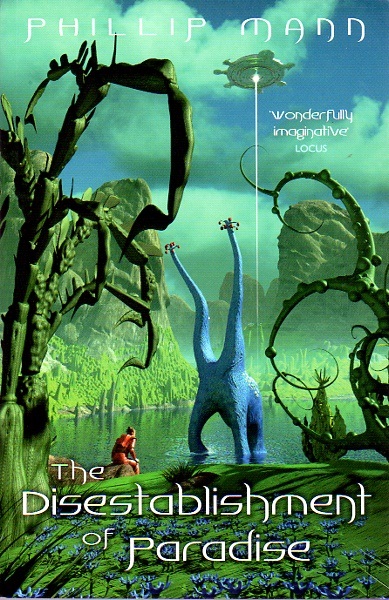
#28: The Disestablishment of Paradise (2013) – Phillip Mann – 4/5
Phillip Mann is an author from New Zealand. I've read two of his older novels—The Eye of the Queen (1982) and Wulfsyarn (1990)--and have been blown away by both. By “blown away” I don't mean from action or twists; rather, I mean by the penetrating insight into the human condition. In Disestablishment, Mann compounds this human perspective with that of a planetary perspective. Humans have been living on Paradise for decades and while their initial foray was successful, something has turned the tables on the efforts of establishing a sustainable colony: crops fail, flora stalk them as prey, and once succulent fruit now poison their bodies. When efforts are made to disestablish the planet, one woman makes a swansong out of her personal and intimate experience with the planet, of which is causing havoc with near-space.

#29: Japan Sinks (1973/1976)– Sakyo Komatsu – 3/5
Mention Japanese novels translated into English and, if they can name one, they'll probably list Japan Sinks. At the height of disaster novels and disaster movies, America imported a favorite Japanese novel to quench their thirst for disaster. This novel has enough geological chaos to sate any disaster palate, but the novel is also heavily geocentric; there are many place names for island, mountains, faults, and villages. It's laden with such geographic proper nouns that it distracts from what should be the primary importance—Toshio Onodera, who is at qualms with his allegiance between his profession and his humanism. The story ends on a humanistic note, but the heap of disaster in the novel distracts from what have been an important piece. (full review)

#30: The Great White Space (1974) – Basil Copper – 4/5
I thought this novel was going to be a horror story about the great depth of outer-space, but it turned out to be a horror story about the great depth of inner-space. Basil Copper is renowned for his Lovecraftian storytelling and this novel epitomizes this skill. There are mysterious hieroglyphics, a deep mission into dark mountains, and a subterranean voyage down into the earth... all in order to confront he Great White Space. Extrinsic monstrosities await the team and intrinsic fears boil over when confronted with the terror in the deep of the earth. I'm not a big Lovecraft fan, but this story had all the right elements to make it a dark and creepy read.

#31: Mandrill (1975) – Richard Gardner – 2/5
Yet another new author for me this month and, with it, an unheard-of novel... the author's only SF novel among his thirty publications. Regardless of experience, the novel comes off as sophomoric. Deforestation has wiped Africa of much of its wildlife and the remaining band of mandrills are enclosed in a laboratory where they can be studied. Though the enclosure presents a natural setting, the alpha male eerily stares into the hidden camera while twitching his face. The scientists are competing for the resource of the mandrills—one wants to decipher its yet-to-be-found language while the other wants to makes drones of them for household use. Among the scientists, the women are the wildcard: one a domineering vixen with spastic swings in allegiance, the other a meek Asian doll carrying the onus that is her mother. Aside from the pre-established sex roles, the rest of the plot is as predictable as the rear cover synopsis makes it.

Sunday, June 14, 2015

Lazy Book Reviews of April 2015


#19: The Collapsium – Wil McCarthy (2000) – 3/5
I read this book back in 2009 and loved it – 5/5. It was idiosyncratically silly and perfectly witty while also being a hard SF novel. It was, according to my memory that seems to have a loose wire, a great and unique novel. I picked it up again hoping to relive the quirkiness ; alas, I relived very, very little of that—so much for nostalgia! Little remained true of my memory: there was a batty, isolated scientist, he was rich and did interesting things in his isolation, and there were silly scenes and witty dialogue... but it was as pervasive as I had remembered. The silly tone quickly took a backseat to a serious, almost somber tone. The theoretical physics was kinda cool but, ultimately, it gets put in the donation pile.


#20: Administrator – Taku Mayumura (1974/2004) – 5/5
A long while ago, perhaps again in 2009, I became interested in Japanese science fiction even though I hadn't read any of it. So I researched the titles of some novels and made a list... and kept that list for five years with coming across a single title—so frustrating! Eventually, I just sent a project proposal to one publisher (Kurodahan) and asked for some titles in return for honest reviews. Having whet my appetite with some short Japanese SF fiction, I plunged into Administrator with gusto. As the title suggests, the crux of the novel (linked short stories actually) hinges on accepting responsibility for ones actions—in this case, it's the responsibility of an entire planet with both its native inhabitants and its colonists. The schism between policy and policing was an insightful glimpse into the mind a salayman, be it far away in space and time. (full review)


#21: The Sheep Look Up – John Brunner (1972) – 4/5
This was also a re-read, a book I had read in 2008... one of my first Brunner novels. It remained etched into my mind, the primary scene(s) in which the choking fumes of the air outside squeezes tears from the man's eyes and sears his throat. The toxicity of everyday life in The Sheep Look Uphave remained locked in my mind as the singular novel where pollution has run its course, leaving humanity gasping in its wake. Even after reading Brunner's Stand on Zanzibar, I liked Sheep more for its simplicity, direction, and portrayal (call me old-fashioned). Sheep, for me, was a bit hard to digest. Neither Sheep nor Zanzibar is my favorite novel; that honor resides within... well, I don't think I actually have a favorite Brunner novel. Hmm.


#22: Recall Not Earth – C.C. MacCapp (1970) – 2/5
To me, a new author, a new book; an unknown author, an unknown book. This kind of gamble at the secondhand bookshop—some turn out to be classics, most end up or mediocre, and a few are so forgettable that, two months later—now—you can barely recall (pardon the pun) any detail. Something along these lines: Aliens destroy Earth, a legion of spacemen were off Earth and escaped with their lives, they all now live on remote planets where most men foster forlorn hope that a cache of women are being held somewhere. Think along the lines of we need our women for breedin' purposes... that's it.


#23: The Long Run – Daniel Keys Moran (1989) – 4/5
I had seen this book on Amazon for a while. Since it had always had rave reviews (nearly all 5s with two 4s), I was compelled to track down the novel. The book is actually a sequel (to Emerald Eyes [1988]) but many have said thatThe Long Run provides enough detail to get by, with which I agree. There's a lot of reference to earlier times in the earlier book, but the reader can understand pretty well. Most parts are thought out well and there's a consistent string of peaks and lulls of action, but the repeated action feels like it getting dragged along thereby wearing itself out through gun battles, ship crashes, and computer hacking.


#24: The Book of John Brunner – John Brunner (1976) – 4/5
It's no secret I'm a big fan of John Brunner. Yet, after reviewing this—my 30-something-ish—book of Brunner's, I realized that I don't actually have a favorite novel of his. I really liked Meeting at Infinity (1961), The Long Result(1965), and Total Eclipse (1974), but none of them has stood the test of time as I can vaguely remember each. Brunner's short story collections are pretty tight—Entry to Elsewhen (1972) and From This Day Forward (1972). Is this collection highlighted, Brunner offers a few original short stories, a few very brief translations, and a cornucopia of literary smatterings, including limericks and poems. It's a great snapshot of a literary and intelligent man. (full review)


Monday, June 8, 2015

1974: Rollerball (Harrison, William)

Largely autobiographical fiction with one SF story (3/5)

Novels are widely regarded to be the most accessible pieces fiction and sell in greater number than collections. Some novels are easily adapted to film—'easy' meaning there is suitable enough material that can be translated from page to film. Given a few minutes, you could easily think of at least a dozen movies that have been adapted from novels; given an hour, you'd probably have more than thirty.

Now regard short fiction. How many movies can you conjure up that have been adapted into film? Yea, that's not as easy, but there are numerous examples even in science fiction:

  • The Fly (1958 & 1986) - George Langelaan's “The Fly” (1957)
  • Rollerball (1975 & 2012) – William Harrison's “Roller Ball Murder” (1973)
  • Maximum Overdrive (1986) - Stephen King's “Trucks” (1973)
  • Total Recall (1990 & 2012) - Philip K. Dick's “We Can Remember It For You Wholesale” (1966)
  • The Lawnmower Man (1992) - Stephen King's “The Lawnmower Man” (1975)
  • Johnny Mnemonic (1995) - William Gibson's “Johnny Mnemonic” (1981)
  • Bicentennial Man (1999) - Isaac Asimov's “The Bicentennial Man” (1979)
  • A.I. Artificial Intelligence (2001) - Brian Aldiss's “Super-Toys Last All Summer Long” (1969)
  • Minority Report (2002) - Philip K. Dick's “The Minority Report” (1956)
  • Paycheck (2003) - Philip K. Dick's “Paycheck” (1953)

Granted, some of these films weren't worth the celluloid they were printed on (I'm looking at you Maximum Overdrive) but they hold a moderate interest in the science fiction community... in particular, William Harrison's short story “Roller Ball Murder”. This is notable because this was Harrison's only SF story. The rest in this collection, and other collection, is largely semi-autobiographical. If you've picked up this collection hoping for varying themes of science fiction, you've chosen the wrong book.

I understand the writer's perspective in writing what you know, but when the same specific themes crop up in a a few stories (pornographic magazines, an interest in nature books, Chicago, the supernatural, the decline of culture, etc.), it begins to feel too personal, not very relevant to the reader. These stories, aside from “Roller Ball Murder”, range from clever to cynical to crass.


The Warrior (1971, shortstory) – 3/5
After professional stints in Korea, Algiers and other exotic parts of call where the dogs of war are needed, one soldier decides to become a mercenary. Temporarily content with his life on the Spanish coast, he dreams of two scenarios: (1) returning to the war of predator and prey and (2) living with his family on the idyllic coast. However, his shattered soldier mentality creeps through his fantasies, resulting in a fantasy of blood, pain, and public chaos. 10 pages

The Hermit (1968, shortstory) – 3/5
In rural Montana, small things tend to cause big stirs. An elderly, isolated man named Ossinger arrives on the outskirts of town and keeps mostly to himself. A local grocer, Cone, provides him with weekly supplies, but their lack of contact inspires the Cone's imagination. Knowing the hermit is an ex-convict, Cone frames the man's personality and sends him further unrequested gifts: books, a dog, a fresh turkey. Dreamlike, the hermit reflects on his life and the bounty of gifts. 19 pages

Down the Blue Hole (1973, shortstory) – 2/5
Homer Bogardus has a big talent and big plans, yet lives in a small town that doesn't need his particular expertise. In Popular Bluffs, however, there's a brisk trade in showing tourists the supernatural. Homer is among the best, being able to conjure a restless dog, summon dead souls through his crystal ball, and his coup de grace—his disappearing act. All he really wants though is to get a girl to love, but even the fulfillment of that wish is lackluster. 12 pages

Eating It (1970, shortstory) – 4/5
Food is fuel, eating is a task—so is the victual life of a young man. Then one day, that same boy's great-aunt exposes him to more than the naughty picture books she enjoys even in her ripe old age—homemade madeleines, French pastries. She teaches him to savor the taste and the texture. With his sensual lesson, the boy looks toward the old wicker chair and a lampshade—as she says, “Everything is tasty.” 8 pages

The Pinball Machines (1967, shortstory) – 3/5
The Great Depression brought men in conflict with, primarily, themselves. Obligations to the family overrode any other duty, even to oneself. This obligation to house, feed, and look after one's own family and even extended family made many men desperate, bringing them in conflict with who they were. But one man, a barber of fine repute, opens his shop for grueling hours yet doesn't alter his working ethos, until a pinball machine enters his shop. Unfamiliar, he ponders its usefulness. 13 pages

Roller Ball Murder (1973, shortstory) – 4/5
The popularity of Roller Ball Murder spans the globe with everyone entertained by the blood, the carnage, he death. The degenerate post-millennial world savors the deaths on screen but the element is somewhat predictable. Jonathon E, a veteran and hero of the so-called game, has lived through years of rule changes, but the season's progressive ruling are steering the game toward slaughter because, after all, the consumers demand it—customers are never wrong. 19 pages

The Blurb King (1971, shortstory) – 4/5
Harry Neal's life has been carried by blurbs alone, blurbs that exaggerate the truth of tell half-truths. Through high school, university, and the start of his career, he realizes the sheer importance of projecting just the right blurb for just the right person. Then, he models his business turning that person into his client. Harry will blurb anyone, anything—aside from writers, who already have a monopoly on sharing blurbs. Even his own life can be blurbed in retrospect. 8 pages

A Cook's Tale (1966, novelette) – 4/5
A chef is just a chef in the eyes of other chefs—colleagues view each other in terms of their own profession for pride, for simplicity. Only two things can transcend this workplace barrier: (1) for the love of a woman or (2) for the love of an art. In one man's case, both apply to his sudden openness to a married woman whose husband is toiling away as a learned man at university. The head chef has a secret desire for classic literature, but succumbs to passion in the form of physical love. 26 pages

The Arsons of Desire (1972, shortstory) – 3/5
As much as he can, Coker bides his time as a Chicago firefighter. He lives at the station and tends to the cleanliness of the same station, yet he has visions of promotion, a dream of which is supported by his acts of heroism while rescuing those trapped in fires. Recently, however, it seems that every call the station gets, Coker is somehow romantically related to the fire's victims. He can't seem to shake the eeriness. 15 pages

The Good Ship Erasmus (1971, shortstory) – 4/5
As cruel as selling cigarettes to a recovering smoker... and that's exactly what one man is doing on a cruise in the Mediterranean. He's smuggled the smokes onto the quitters' cruise and works undercover to paw them off to the most vulnerable victims of withdrawal. Meanwhile, Perry Cheyenne, the passenger host, catches wind of some illicit ciggies, so the smuggler shifts tactics. Eventually, he's taken to see the captain... if he even exists. 15 pages

Under the House (1972, shortstory) – 2/5
Johnny Breck has two things going for him as a professional plumber: (1) he's the cheapest labor in the college town and (2) he enjoys laying his own pipe all over town, especially for the college girls and housewives. He once thought og each act as sort of a “forced entry” but now sees his coital acts as “armed robbery”; regardless, he knows who wants it, where they want it, and knows that he doesn't want to go under the house—no way, no how. 11 pages

Nirvana, Götterdammerung, and the Shot Put (1972, shortstory) – 3/5
Built like a redwood, solid like a rock, yet with a mind as fluid as the rapids between the river's stones, Toby Grogen practices Zen meditation as he tosses his shot put prior to an Olympic event. When left to himself and reflecting within himself, he's able to hurl a record-shattering distance; when observed, he falls short. Once in Germany, his stature and reputation earn him an unprecedented popularity. When faced with competition, Toby takes on a new internal and external route. 12 pages

Weatherman: A Theological Narrative (1973, shortstory) – 3/5

Perched upon his lofty abode of the tower belonging to one of nine Mid-America Storm Towers in the isolated Ozark Mountain, Mr. Pollux is indeed isolated from all people. So isolated, in fact, that he considers himself to be a meteorological god, capable of manifesting even the most exotic of weather events. He submits his observations to central command but ultimately revels in his detachment, power, and death-wish. 7 pages

Sunday, June 7, 2015

1973: Japan Sinks (Komatsu, Sakyo)

Destruction of a country, integrity of a man (3/5)

Sakyo Komatsu is perhaps Japan's most famous translated science fiction, but for all the wrong reasons. Komatsu wrote Japan Sinks for nine years and finally published the novel in 1973, in which he won two awards: the Mystery Writers of Japan Award and Seiun Award. He also has two pieces of short fiction that can be found in English: the grisly and hard-hitting “Savage Mouth” (1968/1978) and the poigantly psychological story “Take Your Choice” (1969/1987).

In popular culture, please recall the films of the 1970s... if you need a reminder of the popular films of the time, here's a short list: Airport (1970), The Poseidon Adventure (1972), The Towering Inferno (1974), Earthquake (1974) and Tidal Wave (1975), to name a few. This was a the golden era of the disaster film, which, in turn, spurred the disaster novel: Scortia and Robinson's The Glass Inferno (1974) and Niven and Pournelle's Lucifer's Hammer (1977), to just name two. Likewise in Japan, after the novel's publication, a string a similar films were produced.

While disaster films and novels were at the peak of popularity, Japan Sinks was translated by Michael Gallagher and published by Harper & Row. Was Japan Sinks translated and published for its artistic merits or to meet a consumer demand for destruction? Regardless, the novel is of two parts: the external disaster inflicted upon Japan and the internal conflict within the protagonist, Toshio Onodera.

It all begins when construction of the Super Express train line is stalled due to the inaccuracies in measuring the land, almost as if the entire landscape had shifted up and down. Then there's a report of a recently made volcanic island disappearing—simply vanishing into the waters of the Pacific Ocean. On the professional side of things, this scares a number of people who host a number of theories; on the government side of it, the entire scenario of Japan sinking is simply absurd; and as for the public, they don't have any idea of what's to come.

Soon, earthquakes strike major metropolitan areas, volcanoes erupt in spectacular fashion, and the death toll begins to climb through the thousands and tens of thousands. The psyche of the Japanese people had become inured to national disasters, so they collectively remain strong and unaware of greater calamity.

Meanwhile, Toshio Onodera has his own sinking feeling. The theory, tests, results, and observations all point to the certain destruction of Japan and the “death of the dragon” isn't in the distant future:

The dragon was stricken.
A fatal illness was eating at him, destroying his very marrow. Racked with fever,his vast bulk covered in bleeding wounds, he thrashed about, vainly struggling against fate that was tearing at him. The encroaching blue sliding over him was like the shadow of death. (169)

Amid the turmoil, Onodera sits on the cusp of allegiance to his government and allegiance to his people. The Japanese people take the destruction in stride, adjusting to their despair with acceptance followed by renewed vigor for accepting lives challenges. But they don't know the future extent of the damaging being wrought. The government insists that if the Japan's forecasted destruction is revealed to the public, an even greater chaos will ensue.

As he continues his research into how and when Japan will sink into the ocean, Onodera experiences an internal conflict: Should be be faithful to the organization or to the people? He asks, himself, “Have I become a faithful bureaucrat?” (130). But he scuttles this idea immediately because a true bureaucrat would never ask themselves that question. With this realization, Onodera know what he must do.

Overwhelmingly, this is a disaster novel through and through. It's also very geocentric with lots of obscure Japanese place names: volcanoes, islands, villages, mountains, oceanic features, subterranean faults, etc. This doesn't distract from the story, but it does leaden the weight of its progression. When one is unfamiliar with Japanese geography, one island sounds the same as another; one town sounds the same as another.


The book's saving grace is the chasm within Onodera. Just because Japan is exploding and subsiding, this doesn't mean that Onodera must also perish; rather, he sees the cataclysm as a test of his self-worth, his loyalty, and his honesty. Much like Japan is between tectonic plates being driven together by deep, fierce forces, so too is Onodera the center of similar intrinsic forces—to be a loyal salaryman or to be a loyal human. In all too many instances, Japanese men have chosen the former and, in Onodera's eyes, the latter is a choice for the greater good. Japan may sink, but Onodera plans to rise above it... at all costs.

Friday, May 8, 2015

1976: The Book of John Brunner (Brunner, John)

Great cross-section of a talented man (4/5)

This hodgepodge collection of Brunner's, aptly titled, is dedicated “TO YOU and everyone else who reads my work. I always wanted to be a writer. But four you I've never have made it. Thanks” (5). And by hodgepodge, I mean there's a lot going on here—so many different facets of the man behind the novels and short fiction.

Within the mosaic of writing, the reader will find:

One (1) cryptic crossword with its solution
Five (5) original short stories (one, an excerpt)
Five (5) limericks
Five (5) essays
Five (5) songs
Five (5) very brief translations
Five (5) original poems

I had only known Brunner for his short fiction and novels... I had no idea he was well versed in so many areas including translations. I've read 27 of his novels and three of his collections... that's a pretty damn big cross-section of a prolific author, yet I've only caught a glimpse of the iceberg that is John Brunner.

While I love to read short fiction, the most interesting inclusion to this kaleidoscope of Brunner is his passing comments on a number of topic-related novels and short fiction that I've never come across:

Novels:
Eric Frank Russell's Sinister Barrier (1939)
Evelyn Waugh's The Loved One (1948)
Naomi Mitchison's Memoirs of a Spacewoman (1962)
Bernard Wolfe's Limbo (1952)
H.G. Wells' The World Set Free (1918)
John Hersey's The Child Buyer (1960)

Short stories:
Arthur Porges's “$1.98” (1954)
James Blish's “Common Time” (1953)
Hal Draper's “MS Fnd in a Lbry” (1961)
Rog Phillip's “The Yellow Pill” (1959)

I'm not one who enjoys reviewing crosswords, limericks, essays, songs, or poems... so I offer only six short reviews: four of the short stories (minus the excerpt), a French translation of a short story, and one of Brunner's poems which struck a cord in me.

------------

“Bloodstream” (1974, novelette) – 3/5
There's a lot of history between Christopher Hill and William Bush, but that was ten years ago and in university. Chris has always envied Bill for his style, charm, and intelligence, but the same Bill he almost runs over in the middle of the street has fallen into disgrace. Unperturbed, Chris later meets Bill in his slum house where Bill launches a diatribe about human evolution and the city as an organism, all the while holding Chris captive by his own warped, internal logic. 18 pages

“Hide and Seek” (1973/1973, short story) – 4/5
Original: “Cache-cache” by Gerard Klein, translated by John Brunner
The often purported Theory of Everything has been rumored to exist in many places and faiths, but mathematicians and physicists know that it simply lies in the details. Most, however, feign from delving into exhaustive detail as it requires hundreds and thousands of pages and hours to describe details across multiple disciplines. Of course, that purported Theory of Everything is the existence of God, but where the details lie, does the devil lie within, too? 1 page

“Who Steals My Purse” (1973, novelette) – 4/5
Insults were directed toward the US by a southeast Asian nation and the President has announced that the American people won't stand for the accusations. Immediately, America is divided into the pro—those who seek direct resolution—and the con—those who urge pacifism. Barney is a TV political reported who is assigned to capture the mounting tension prior to the Senate's judgment in seven days. Meanwhile in southeast Asia, Cham Loc tends to his poor fields and family. 32 pages

“When Gabriel...” (1956, short story) – 4/5
Running and rounding a corner on their way to perform at a jazz concert, two musicians run into a shifty-looking miscreant  who, while upon leaving, gives a wrapped trumpet to the trumpeter. As he unwraps it, he sees it's the most beautiful trumpet of all, yet without make or serial number. Once at the concert, situated in a crypt, the man sticks to his regular trumpet, saving the elegant one for a jam afterwards. The notes blown are perfect, yet within the crypt, something has been called forth. 9 pages

“The New Thing” (1969, short story) – 4/5
More than 10,000 years ago, the human race created the Record Registry, a massive computer that's able to analyze every accomplishment bu every alien species that has ever existed in the universe. The creation of the Registry was a first amid the universe—it was also mankind's first and last Record of any sort. It was supposed to fuel ambition, but it has smothered progress. One man from Earth wishes to challenge three Records at once. 14 pages

“The Atom Bomb is Twenty-five This Year” (1970, poem) – 5/5

John Brunner has long been a fierce opponent of nuclear weapons. He once wrote lyrics along the same lines for a protest song called “The H-Bombs' Thunder”, sung to the traditional music of “Life is Like a Mountain Railway”. Here, Brunner asks why we and our children should suffer from our leaders' choices. The same theme is found in this poem, but on a much more personal note: Why can the government instantly kill thousands of innocent people with a bomb, but one woman can't euthanize herself from the effects of the bomb? 2 pages